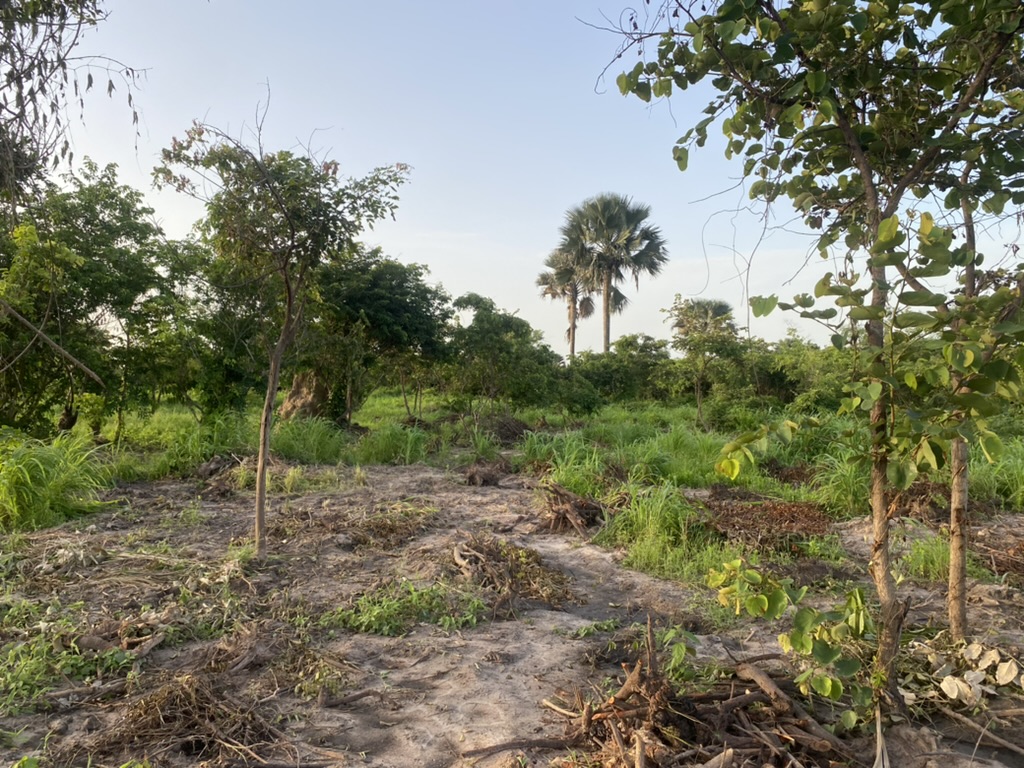
In late 2023, FAIR Farms Gambia lost access to the land we built our pilot demonstration and research farms, Gambia Goat Dairy and FAIR Farms Gambia.
From empty land in 2018, we built a demonstration and research farm. Doing so we:
- Drilled a solar-powered borehole to provide water for the entire farm (2018)
- Permanently enclosed the 10 acre land (2018)
- Raised a goat herd to over 40 animals (2019-2021)
- Two milking data collection over two lactations showing nutrition had significant influence on milk production
- Sold live bucks for revenue
- Built a goat barn (twice! – a smallholder model and commercial scale barn!) (2018-2019)
- Developed new national and international feed supply chains (2019-2024)
- Bulk purchased hay from up-country in Gambia, reducing purchased hay costs by 10%
- Contracted hay from local farmers, by covering input costs (purchase of groundnut seeds) for the farmers, who then farmed and sold the groundnuts and provided us with groundnut hay in exchange. Reduced our costs by 65% and linked our farming success with the success of other farmers.
- Purchased 1 ton of ruminant dairy concentrate feed from Senegal, exploring feed supply chains and the more developed manufacturing sector of the neighboring country. Doubled peak milk production when fed to our West African Dwarf goat herd
- Shipped 240 tons of corn grain from Lancaster County, Pennsylvania USA to The Gambia with farming partner, G-Farms (2022)
- Exploring long-term, recurrent bulk feed shipments from USA to The Gambia (2024)
- Built a 10m x 10m feed storage, laboratory and office building (2021)
- Raised rabbits – and used food waste to significantly reduce feed costs by up to 85% (2022-2024)
- Built an irrigated garden (0.7 acres) (2023-2024)
- Composted livestock manure for fertilizer (2021-2024)
- Initiated silvopasture – a climate change resiliency strategy of planting trees in pasture grasses to improve soil water retention, fertility and health, and reduce animal heat stress (2022-2024)
- 0.7 acres by planting trees into pasture grass
- 2 acres thinning Gambian bushy shrub into native tree silvopasture
- Grew fruit trees (2020-2024)
- Raised crops and drought tolerant pasture grasses (2019-2024)
- Held community small ruminant vaccination clinics annually since 2021:
- Vaccinating on average ~70 sheep and goats across 3 locations (and adding 55 dairy cattle in 2024!)
- In line with national veterinary strategies for control and eradication of for PPR and Pasteurellosis in small ruminants – endemic diseases to The Gambia causing high morbidity and mortality, and preventable with annual vaccination
- Supported UPenn Student Research Projects, undergraduates, veterinary students, MPH, MES, and Wharton business students including:
- Milk marketing survey exploring rural, semi-rural, and urban milk product availability and pricing (2018)
- Solar capacity and projections of a demonstration and research farm (2018)
- Pasture stewardship and management (2019)
- Baseline nutrition survey of women and children to monitor long-term impact, collecting data from over 700 Gambian participants (2019)
- Poultry feasibility study (2020-2022)
- West African Dwarf Milk Production analysis (2021)
- Infectious disease control for West African Dwarf goats (2021-2022)
- Microfinance models to support smallholder farmers (2022)
- Animal-sourced foods effect on iron deficiency anemia: A Randomized Controlled Trial (collaboration with MRC Gambia) (2022)
- Dynamic product marketing and sales model (2022-2023)
- Contextualizing Social Impact and Evaluation Tools (2023)
- International supply shipments to support operations and an integrated micro-finance program (2023)
- Educational dissemination networks and platforms (2024)
- Bulk feed shipment strategies from USA to Gambia (2022-2024)
- Employed over 300 people through full-time, part-time or contract service work
- Welcomed over 100 visitors to the farm
When we officially partnered with Penn Vet, our landowning organization charged rental costs we couldn’t justify – just two years of rent would be sufficient to purchase land.
We lost significant investments into the property, not including the intangible efforts to improve land quality and fertility made during the 6 years we stewarded that land. Losing so much, so relatively early in our journey, while devastating, proved what we already knew – we were on something worth fighting for.
For more on our this story, watch this message by co-Founder, Brianna:
Land access is the most critical issue in farming – and we’re taking the steps with your help to purchase, preserve and steward farmland forever into the future for agricultural education.
 FAIR Farms Gambia